The Guardian of the Ridge
The Texas heat pressed down like a living thing, thick and merciless, turning the air into something you could almost chew. Dust clung to the asphalt, and the horizon shimmered as my pickup rattled to a stop outside the gates of Fort Blackhawk. The engine coughed once, shuddered, and died.
For a moment, I stayed where I was, hands resting on the cracked steering wheel, leather warm beneath scarred palms.
Fort Blackhawk.
It had been a lifetime.
The name unlocked memories I’d spent a decade trying to bury. Not nostalgia—nothing that gentle—but the sharp, sensory kind that scraped raw. Sandstorms that flayed exposed skin. Cordite hanging thick in the air. Mortars screaming down from nowhere. Radios crackling with voices that knew they might not be heard again. Blood drying on my hands—sometimes mine, often not.
And always, the whispered call sign:
Aegis.
A name I no longer answered to.
Ten years since I’d walked away from the uniform. From the medals I refused. From the life that had burned me down to the bone and rebuilt me into something quieter, harder, and far more tired.
I’d tried to live normally. Bought a small house in rural Montana. Became an EMT, then a paramedic instructor. Taught kids how to splint fractures and breathe into rubber lungs. Dated a kind man who didn’t ask about the nightmares. Planted a garden. Adopted a three-legged dog named Murphy.
It looked like a life.
It felt like a disguise.
Helicopters still made my hands shake. Soldiers at gas stations made me look away. Nothing filled the hollow left behind when war takes the part of you that believed in endings.
Then the phone rang.
Blocked number. I almost ignored it.
“Is this Captain Laura West?”
“There’s no captain here,” I said. “Just Laura.”
Colonel Andrew Mercer laughed, dry and familiar. “Bullshit. I need you.”
We talked for two hours. About kids being sent into hell without the tools to survive it. About medics freezing under fire. About soldiers dying because the book didn’t cover chaos.
“They know the protocols,” Mercer said. “They don’t know how to improvise when the world collapses.”
I said no.
Then he said, “They’re dying, Laura. And you’re the one who knows how to stop it.”
So here I was.
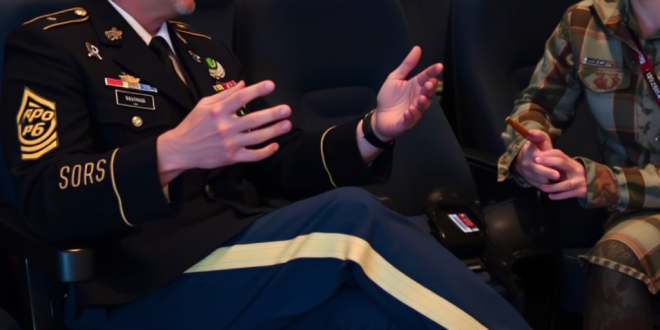
I climbed out of the truck, joints protesting, and adjusted the faded BDU jacket I’d debated wearing. Officially authorized. Emotionally… complicated. No rank. No patches. Just fabric worn soft by history.
The guards barely looked at me.
Inside, the base was polished and pristine—glass, steel, air-conditioning. Nothing like the dirt-carved outposts burned into my memory.
I was halfway across the lobby when I felt him—starched fabric, expensive cologne, confidence without depth.
“Ma’am,” the lieutenant snapped, stepping into my path. “Civilian contractors are not authorized to wear military uniforms. Remove it. Now.”
The room went quiet.
I slid my paperwork across the counter. “I’m authorized.”
He didn’t look.
“That uniform is for soldiers,” he said louder. “Real soldiers. You didn’t earn it.”
A Master Sergeant near the door stiffened. The older ones always knew.
I could’ve ended it there. Made a call. Destroyed his morning—and maybe his career.
Instead, I nodded.
“All right.”
I shrugged off the jacket.
The silence broke—not with sound, but with breath.
My back was bare. A white tank top left nothing hidden.
The tattoo stretched from shoulder blade to shoulder blade—faded ink over scarred flesh. A combat medic cross wrapped in hard-edged wings. And beneath it, a date burned into memory as much as skin.
07 • MAR • 09
Takhar Ridge.
A battle buried under redacted reports and quiet legends. Twenty-three men who should’ve died.
Saved by a medic who refused to let them.
The whispers started.
“No way…”
“That’s her.”
“The Guardian.”
“Aegis.”
The lieutenant’s face drained of color as realization hit.
Then Mercer came running.
“Captain,” he breathed. “Captain West.”
The word fell like a hammer.
“Lieutenant,” Mercer said softly, dangerously. “Do you know who you just ordered to undress in my headquarters?”
He didn’t wait for an answer.
“She saved twenty-three men under sustained fire. She rewrote trauma care with a knife and her hands. The protocols you teach? She wrote them in blood.”
The lieutenant stared at the floor.
“I didn’t know—”
“You didn’t look.”
I pulled my jacket back on.
Then a soldier stepped forward.
“Ma’am… you won’t remember me.”
He rolled up his sleeve. The same date, scarred into his skin.
“I was nineteen. You kept me awake. Told me to think about my girlfriend. I married her. My son turns five today.”
A tear slipped free before I could stop it.
“What’s his name?”
“James. After the kid who didn’t make it.”
I remembered.
Before the moment could settle, Mercer spoke again.
“Lieutenant Bishop. Apologize. Then escort Captain West. You will observe. You will learn.”
Bishop did.
And he did learn.
The Teaching
For six weeks, I taught without slides or manuals.
I broke them gently. Then thoroughly.
I taught them how to think when everything failed. How to improvise. How to choose. How to keep moving when fear screamed at them to stop.
Bishop watched every session.
So did the ghosts.
Veterans came quietly. Nods replaced words.
That mattered more than medals ever had.
The Farewell
There was no ceremony.
Just salutes.
One by one, they spread across the base—not for rank or regulation, but for understanding.
They weren’t saluting a uniform.
They were saluting survival.
As Fort Blackhawk disappeared in my mirror, the weight didn’t vanish.
But it shifted.
And for the first time in years, it felt like something I could carry.
Final Thought
Strength doesn’t always announce itself.
Sometimes it wears faded cloth, carries quiet scars, and chooses—again and again—to help others survive the fire.
Never mistake silence for weakness.
Some battles are so loud, the survivors learn to speak softly.
THE END